Welcome to the Napaku-Gérard foundation.
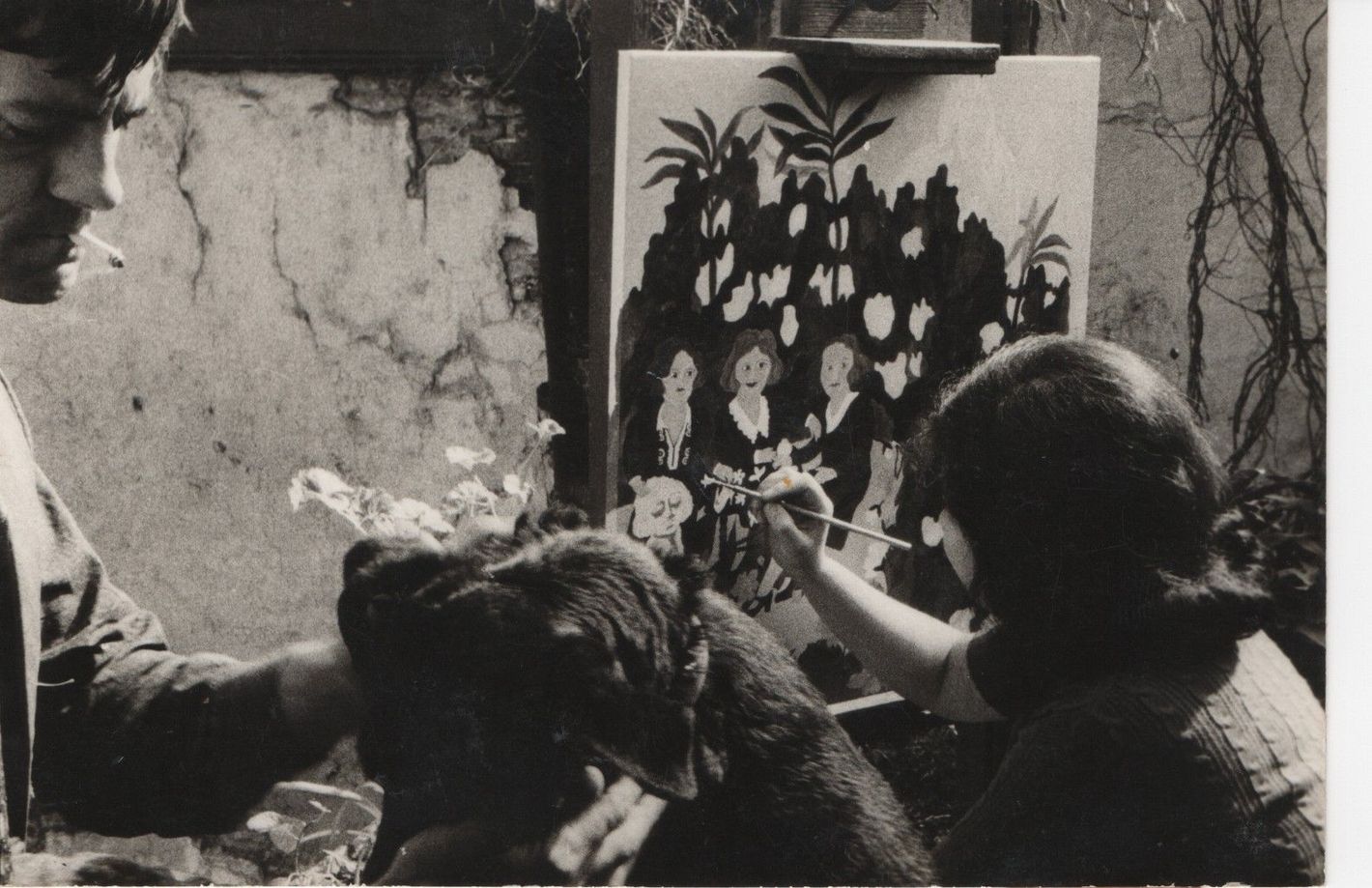
Made to preserve the art of Piet van den Heuvel (Napaku) and Thea Gérard.
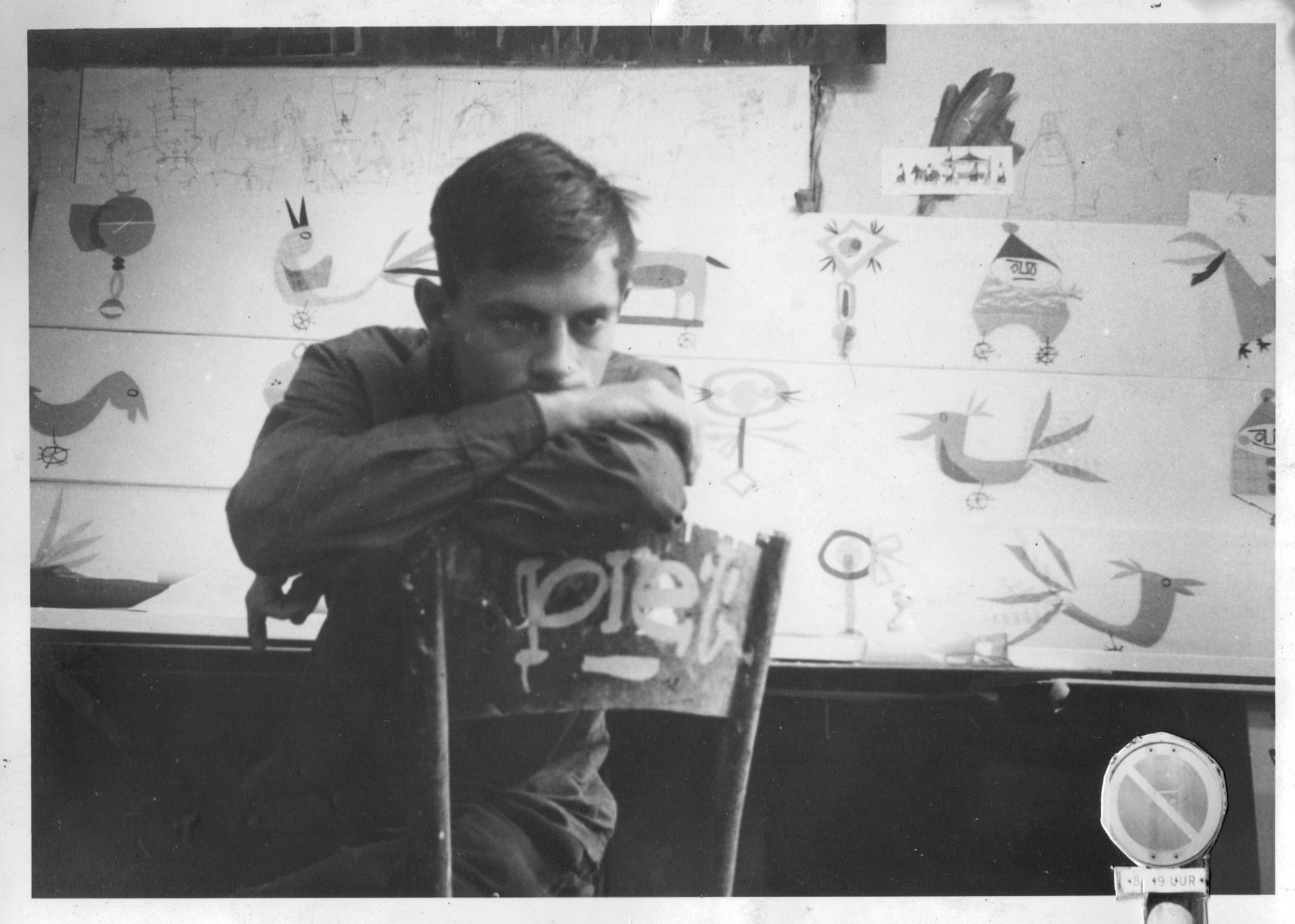
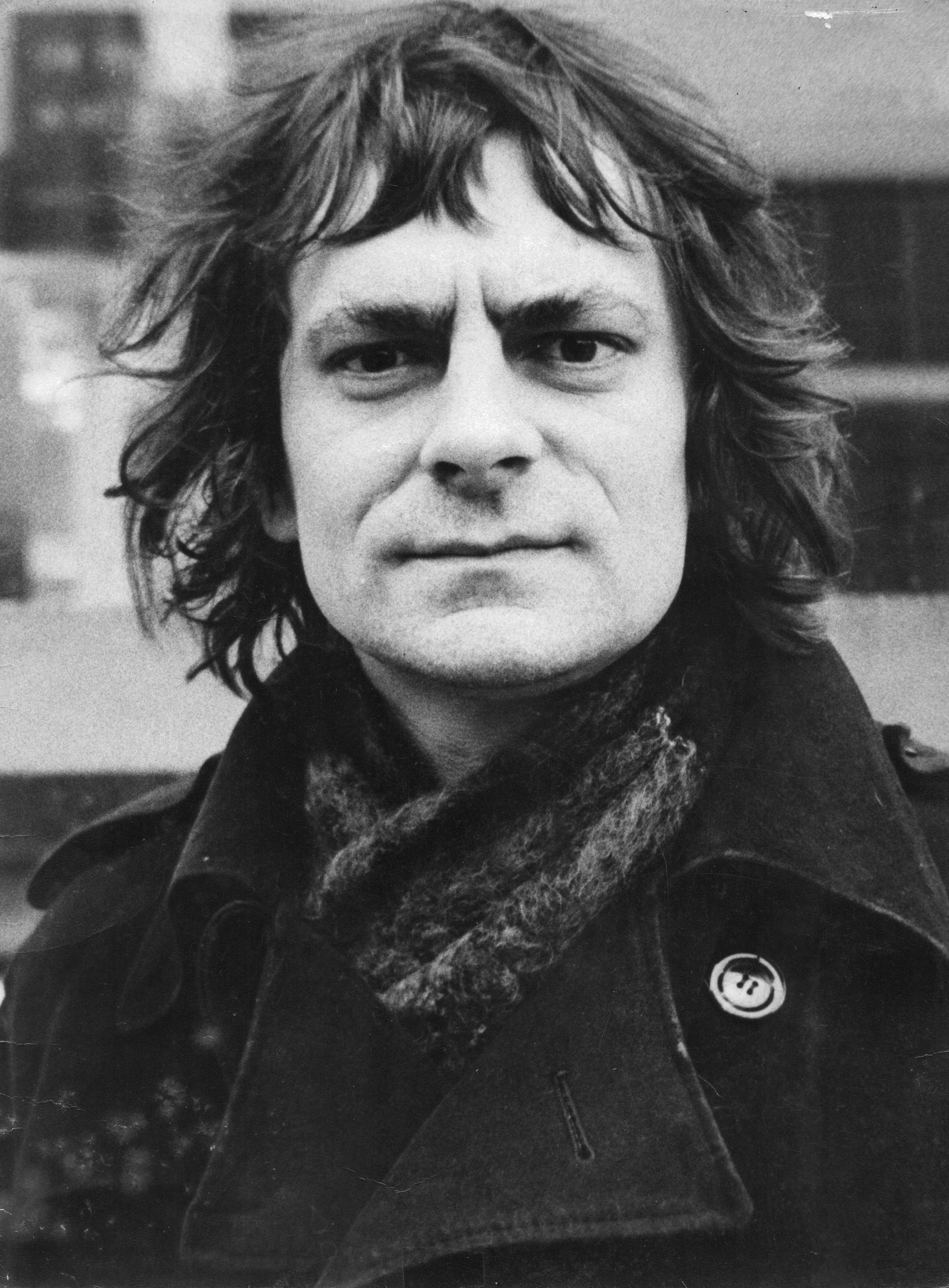
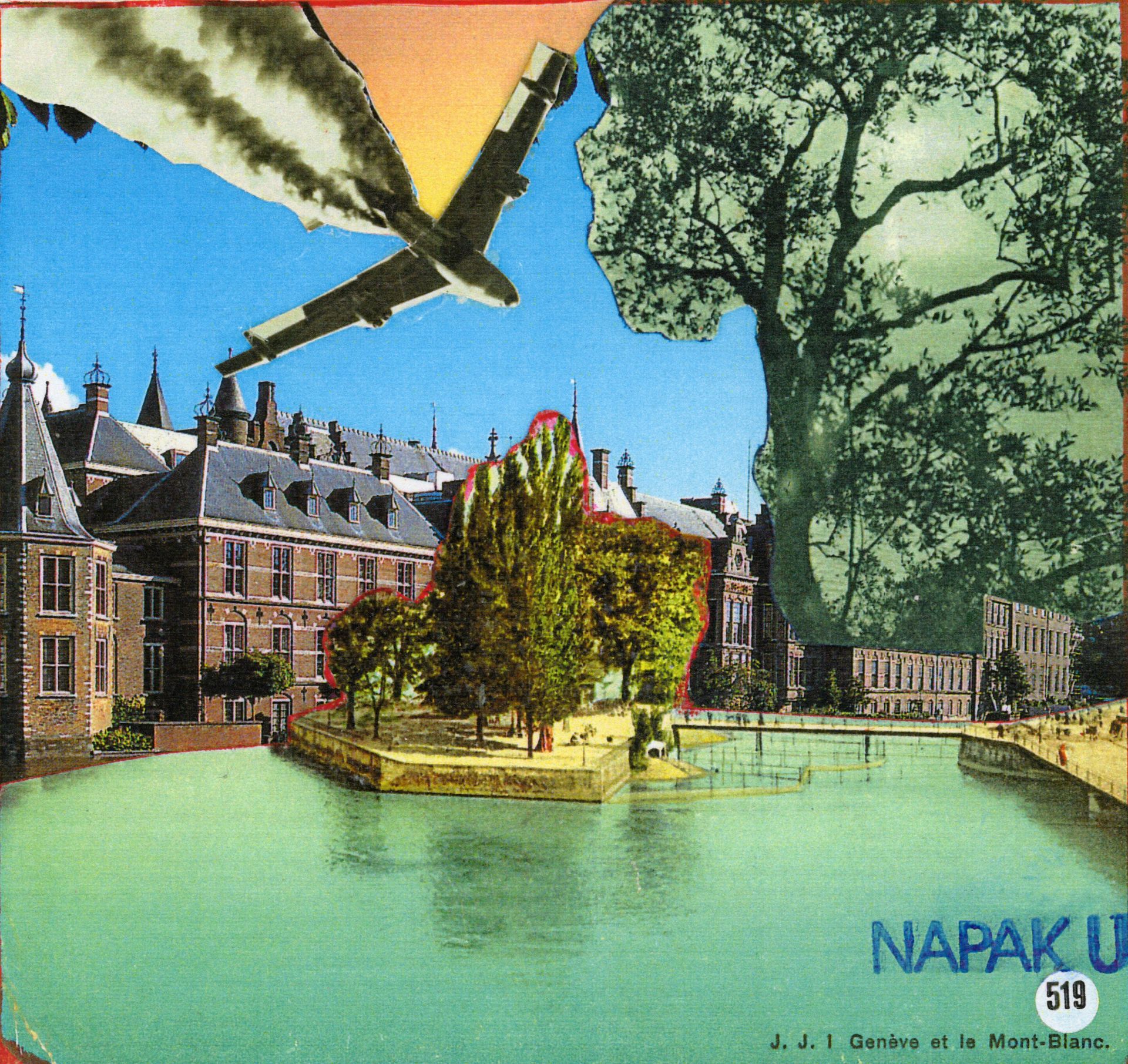
Piet van den Heuvel, better known as Napaku, was a multidisciplinary artist from The Hague whose life and art were inseparable. Trained at the Royal Academy of Art in The Hague, he developed a highly personal visual language
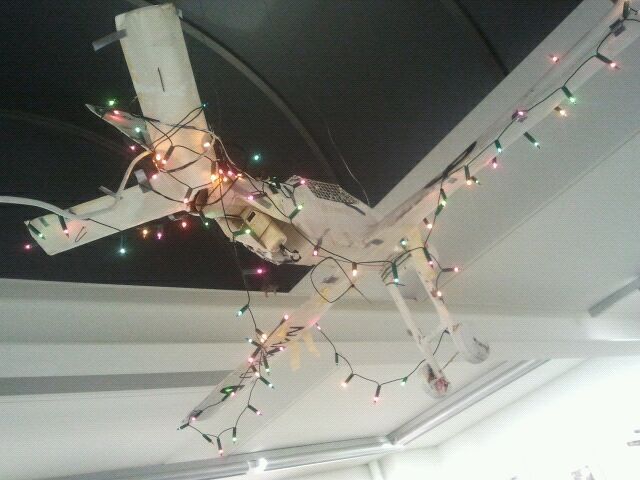
that moved freely between collage, mail art, drawing, assemblage, graffiti, artist books, altered records, diaries, installations and handmade airplanes.
Working from the late 1950s until his death in 2004, Napaku transformed everyday materials—postcards, magazines, photographs, found objects and handwritten notes—into poetic, humorous and often surreal compositions. His work reflects a fascination with imagination,
freedom, memory and the absurdity of everyday life. Precision and playfulness coexist in an oeuvre that is deeply personal yet universally recognisable.
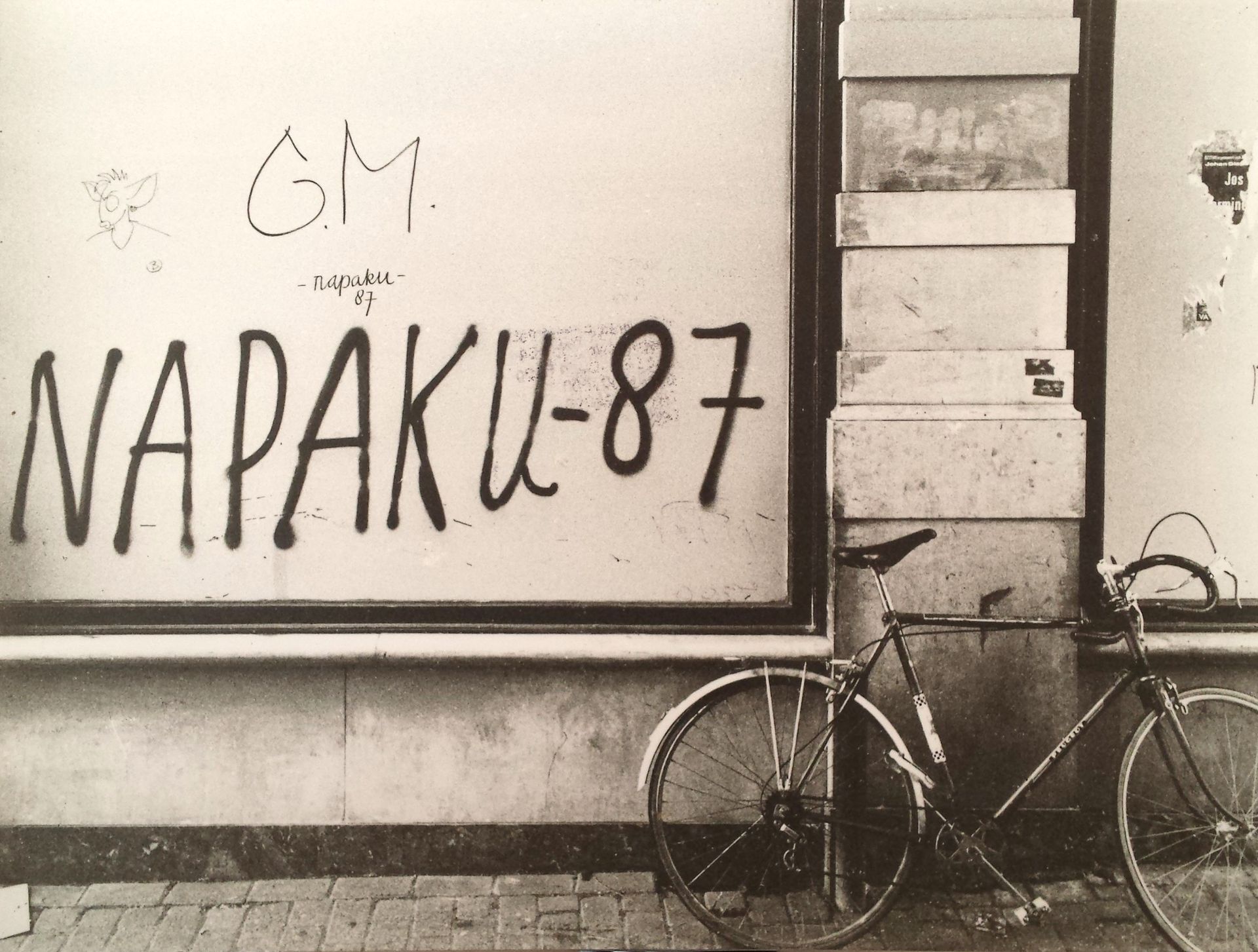
Known in The Hague not only for his studio practice but also for his presence in the streets, Napaku left traces of his artistic world in public space through graffiti and interventions, while maintaining an intimate correspondence practice through handmade
mail art and postcards. His friendship with fellow artists, including Daan van Golden, formed an important part of his artistic network and legacy.
Today, Napaku’s work stands as a unique artistic universe in which art and daily life continuously merge. Through the Napaku-Gérard Foundation, his work is documented, preserved and shared with new generations.
Napaku (Piet van den Heuvel, 1935–2004)
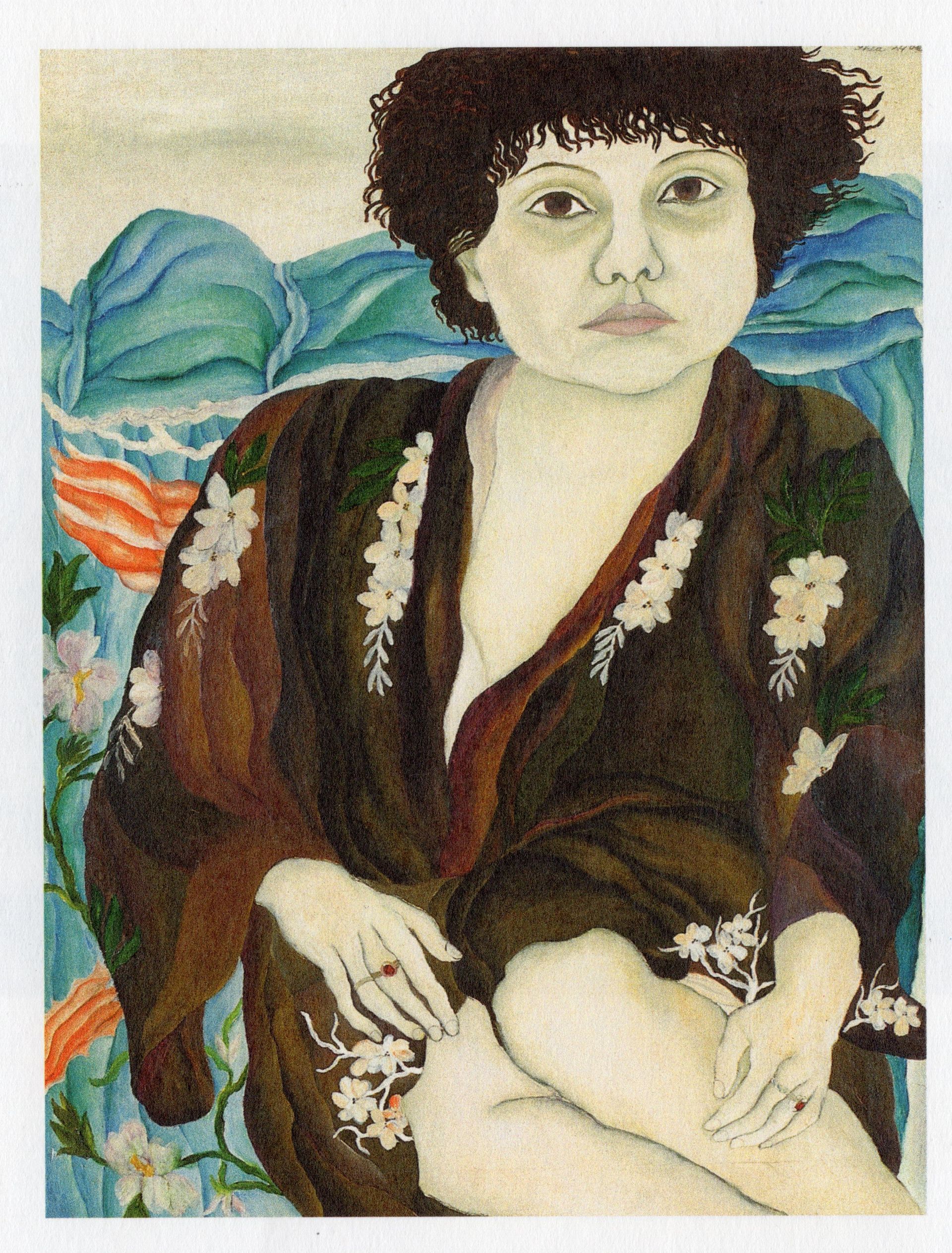
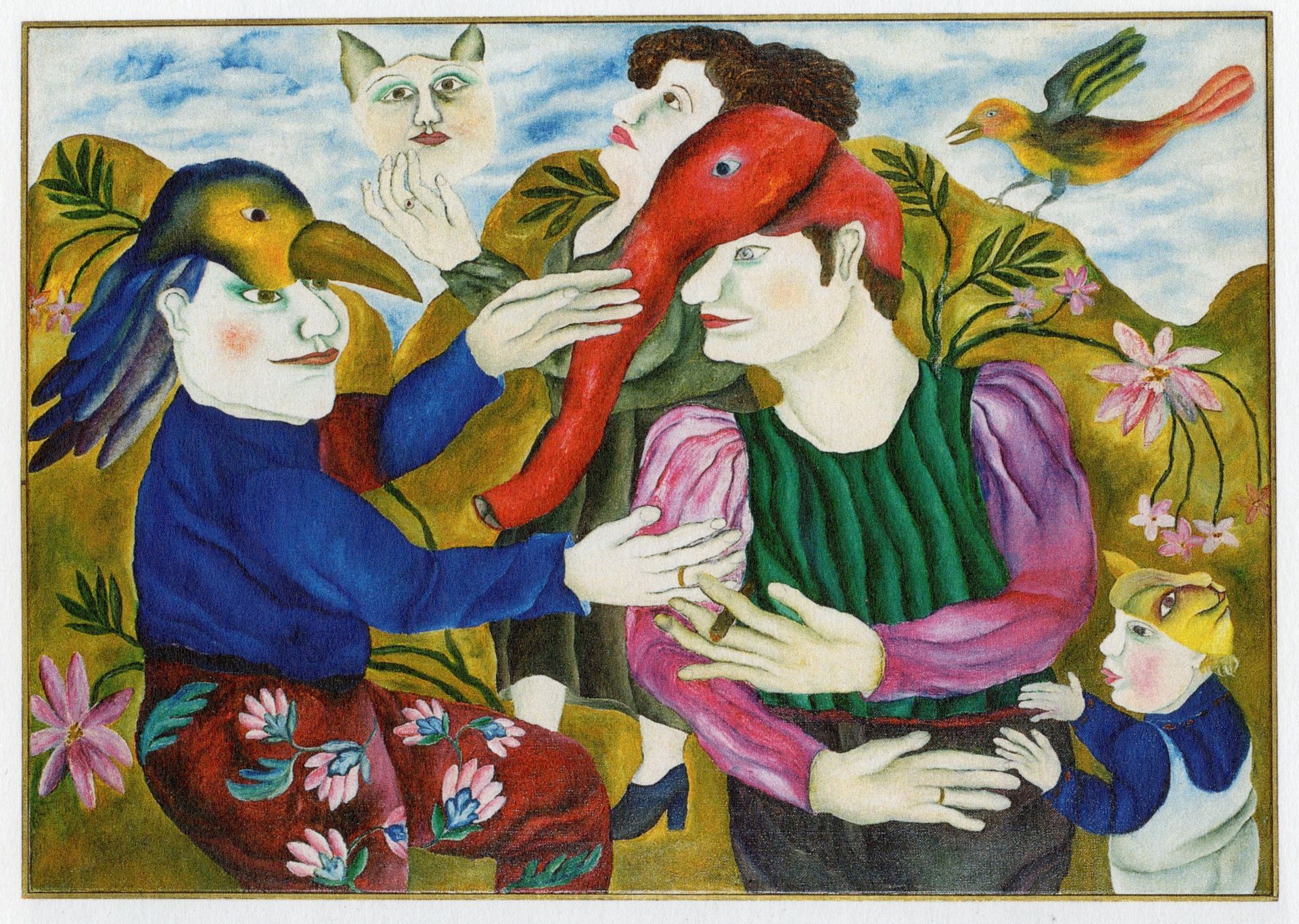
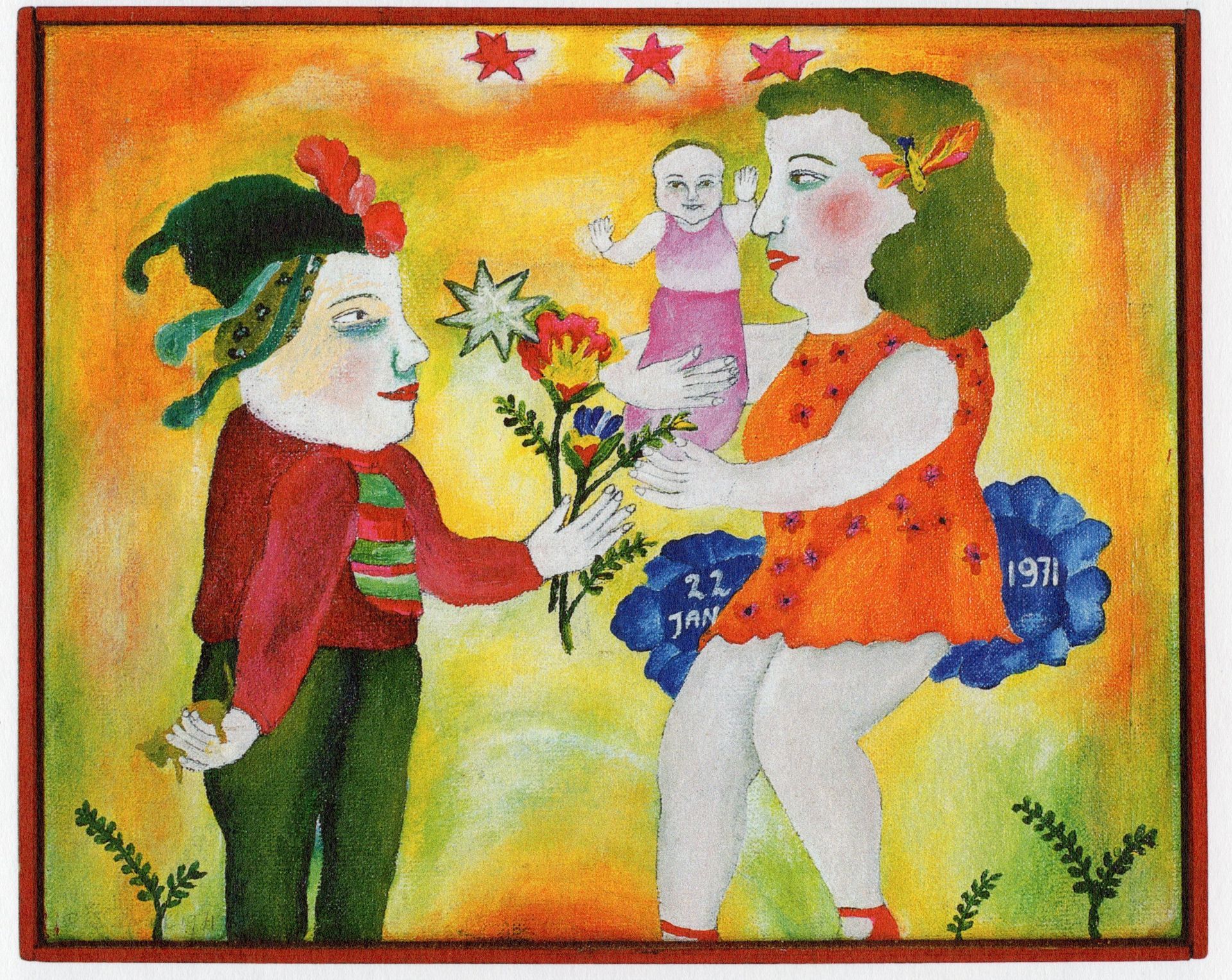
Thea Gérard was a Dutch artist whose deeply personal and imaginative work transformed memory, family and everyday life into vivid visual storytelling. Born in Jakarta, Indonesia, and later settling in The Hague, she developed a distinctive artistic voice inspired
by childhood memories, personal relationships and the emotional landscape of belonging, nostalgia and identity.
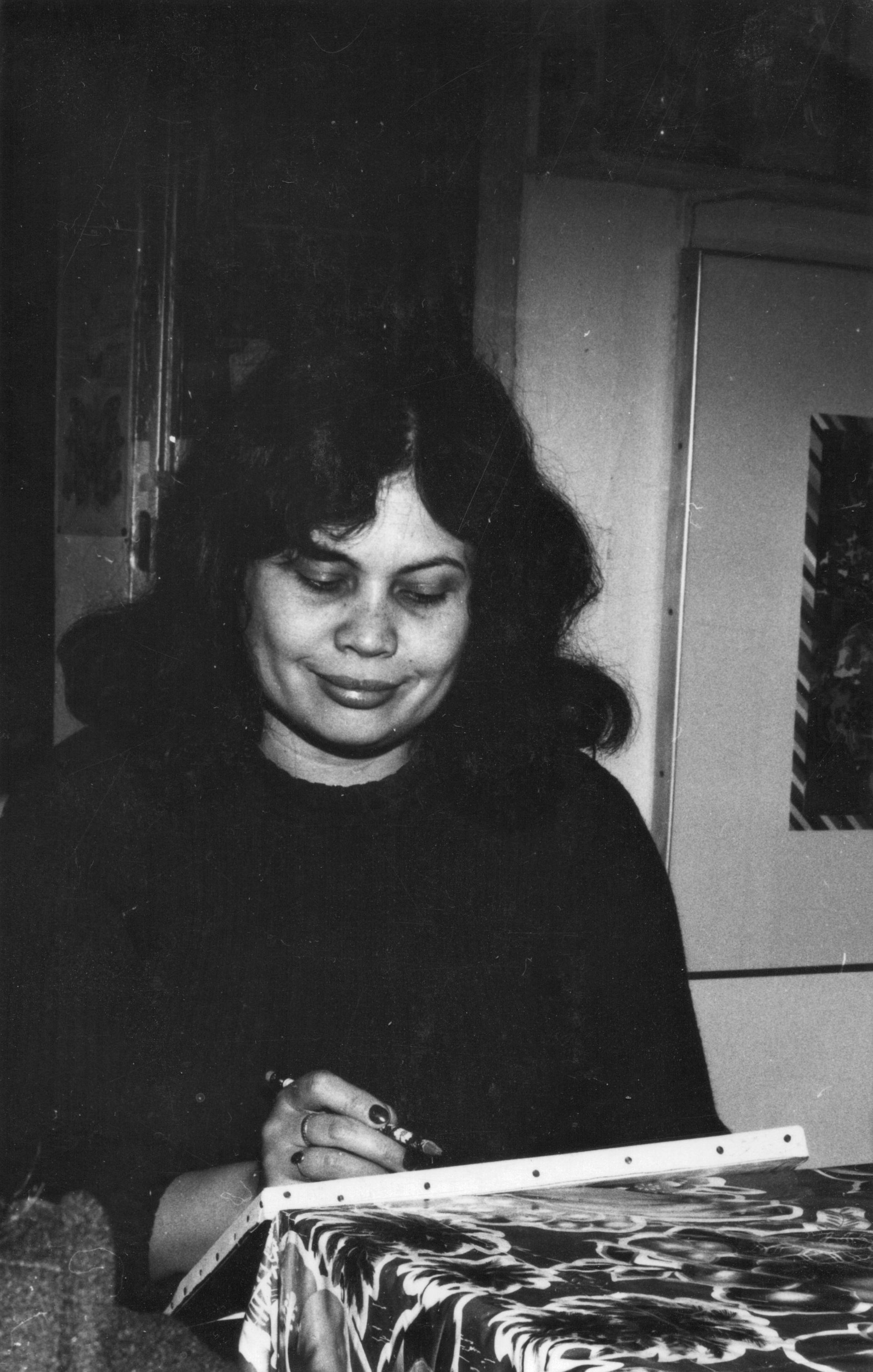
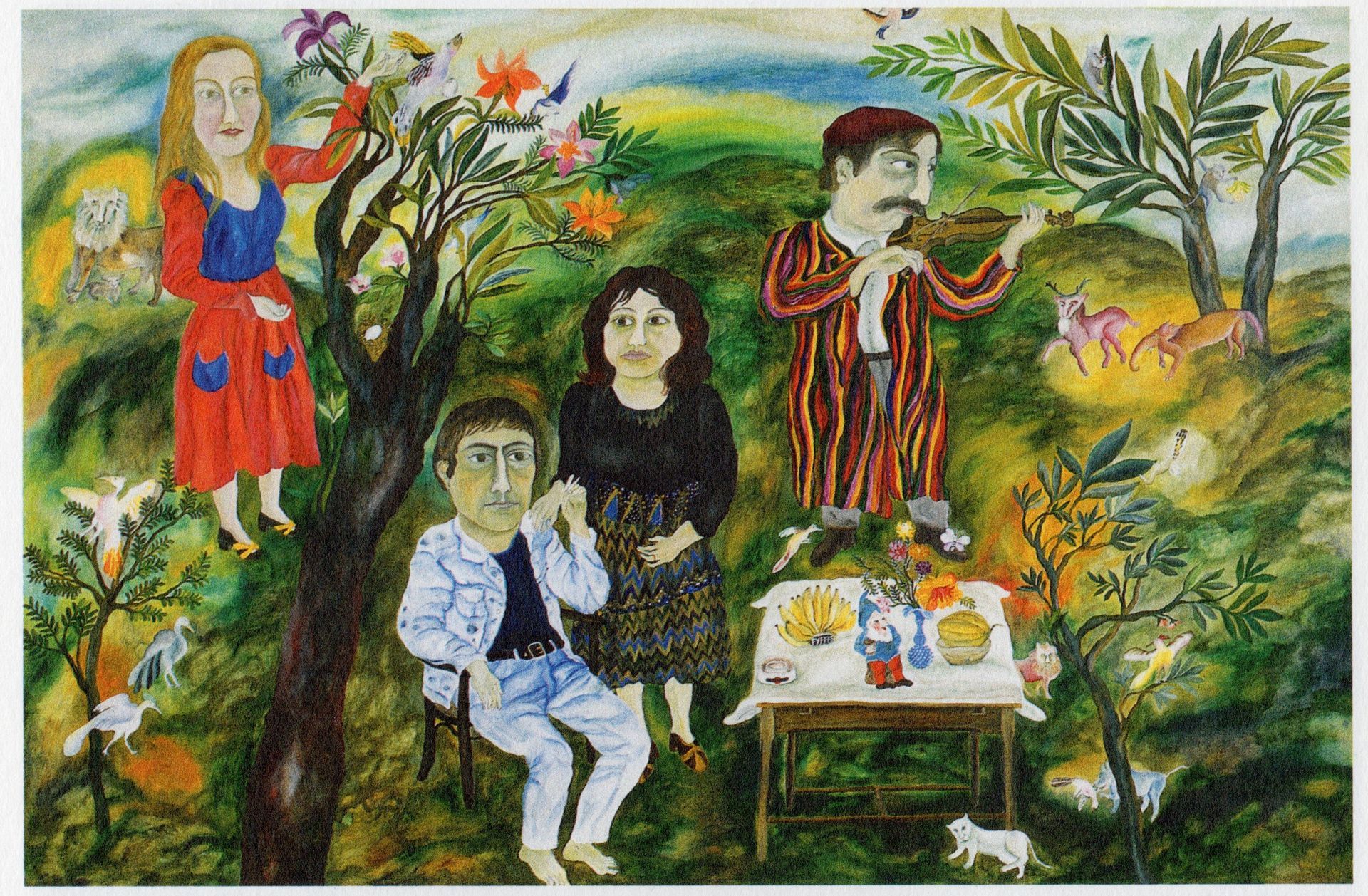
A self-taught artist, Thea Gérard worked across painting, ceramics, woodwork, embroidery and poetry, creating an intimate and recognisable world populated by portraits, family scenes, flowers, animals and dreamlike recollections. Her paintings are often associated
with naïve art, yet they reveal an expressive emotional depth in which tenderness, memory and melancholy quietly coexist. Portraiture became one of the defining elements of her oeuvre, capturing friends, family and artistic companions with warmth and remarkable
psychological presence.
Throughout her career, Thea Gérard created an artistic universe in which life and art continuously intertwined. Her work serves not only as a personal archive of memory and emotion, but also as a unique visual testimony to migration, family life and artistic
imagination. Through the Napaku-Gérard Foundation, her work is documented, preserved and shared with future generations.
Thea Gérard (1938–1987)

For further reading about Piet van den Heuvel (Napaku) and Thea Gérard, here are some links.
More about Piet van den heuvel
https://erikquint.nl/napaku-mijn-vrouw-weet-ook-niet-wat-ik-doe-en-waarom-1999/ target=”_blank”
In 1999, Daan van Golden put together an exhibition at Stroom as a curator.
In 2012 there was a retrospective exhibition at Heden on the Denneweg in The Hague. Follow the opening via
Extra Information about Napaku
https://villalarepubblica.wordpress.com/2012/09/06/napaku-piet-van-den-heuvel-bij-heden-den-haag/
In 2014, Van den Heuvel's work was on display at the Kunstmuseum The Hague in the exhibition Complex Images:
https://www.kunstmuseum.nl/nl/tentoonstellingen/ingewikkelde-beelden
Even more about Piet van den Heuvel.
https://www.instagram.com/napakujr?utm_source=qr&igsh=OWY2YWxlOWpvcm40
Napaku at the Vrije Academie
Piet van den Heuvel (Napaku) - De Haagse Vrije Academie - Psychopolis
A video about Thea Gérard
A collection of the art of Thea Gérard
Wikipedia
Street interview with Napaku
News:
10-08-2026
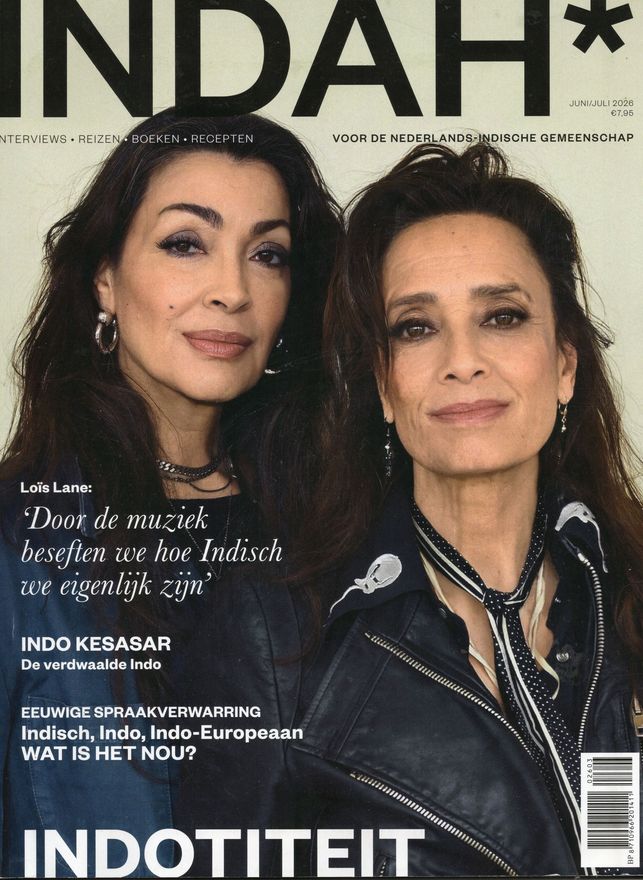
A recent issue of Indah magazine featured an article about the life and work of Thea Gérard (1938–1987). The article also included a call to readers to come forward with paintings and other works by Gérard that may still be held in private collections.
The appeal is part of the ongoing Napaku–Gérard Foundation project to document her artistic legacy in preparation for a future exhibition and book publication.
We are very pleased that the article has already generated several valuable responses. As a result, works by Thea Gérard have resurfaced that had not previously been included in our inventory. These discoveries help us build a more complete picture of her artistic career and of where her work has found a home over the years.
The newly discovered works will first be photographed, documented and added to the archive. Once this process has been completed, we look forward to sharing some of these works and the stories behind them here on the Napaku–Gérard Foundation website.
Do you own a work by Thea Gérard, or do you know of work in a private collection? We would still be very interested to hear from you.
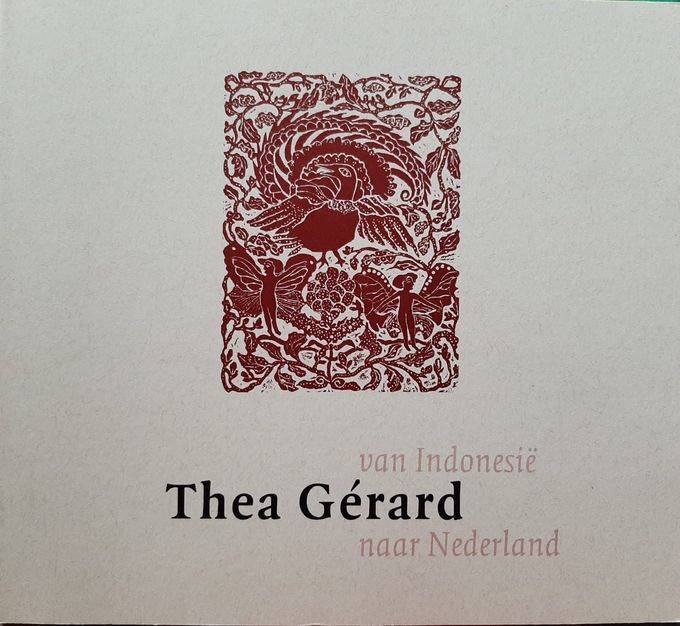
Thea Gérard at De Stadshof, Zwolle, 1996
In 1996, nine years after her death, Thea Gérard’s work was presented in an exhibition at De Stadshof in Zwolle. It would become the last major exhibition devoted to her work to date.
The exhibition originated as the graduation project of Carolien Satink, who carried out extensive research into Gérard’s life and artistic career. Satink also wrote the accompanying publication, Thea Gérard – van Indonesië naar Nederland, placing her work within the context of her personal history and her journey from Indonesia to the Netherlands.
As part of the project, a substantial number of paintings, drawings, sculptures and other works by Thea Gérard were traced and documented. Although the inventory was far from complete, it created an invaluable foundation for understanding the scope of her oeuvre.
Thirty years later, the Napaku–Gérard Foundation is able to build on this pioneering work. Carolien Satink has generously made her complete research archive available to the Foundation, including documentation gathered during the preparation of the 1996 exhibition.
This material now forms an important starting point for a renewed effort to locate, document and catalogue Thea Gérard’s work. New works continue to emerge from private collections and family archives, gradually adding pieces to a story that was never fully recorded.
In this way, the research begun in Zwolle in 1996 is not a closed chapter, but the foundation for a new one.
Zoklan-Pok
A Collage on the Move — 1969–2003
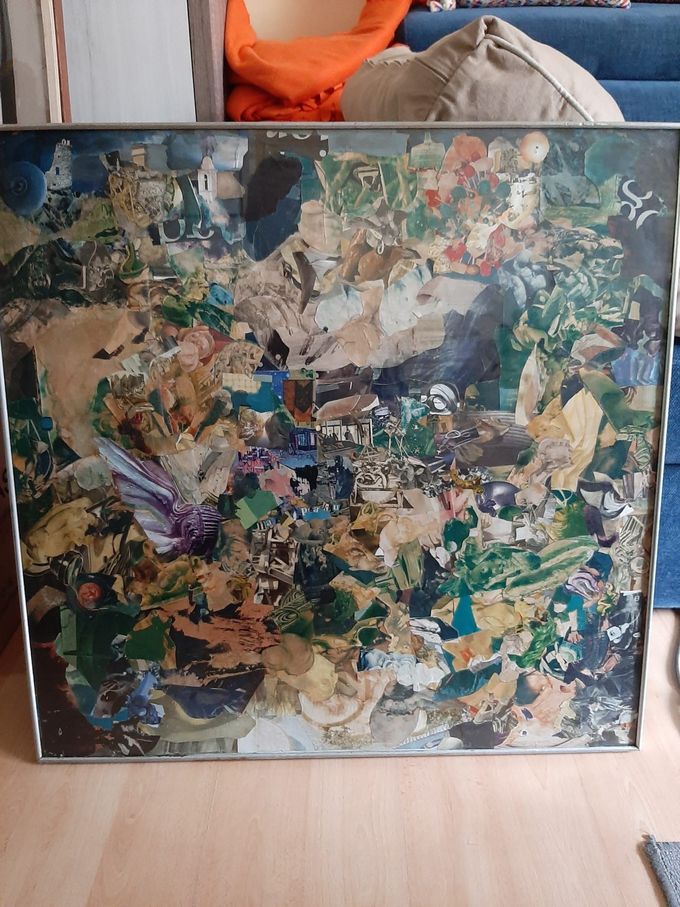
This collage by Piet van den Heuvel has not only a front and a reverse, but also an unusually long history. The work was originally created in 1969, yet it was never truly finished. Over the course of more than thirty years, Piet returned to it several times, repairing it, altering it and adding new elements. In this way, the collage became not just an artwork, but also a tangible record of the passage of time.
Quite literally, the work travelled a long way. For many years it was kept aboard the inland cargo vessel the Geertje, owned by Piet’s brother, André van den Heuvel. As the Geertje travelled through the Netherlands, the collage travelled with it. This alone gives the work a remarkable history. Rather than remaining safely in a studio, collection or museum storage, it became part of everyday life aboard a working ship.
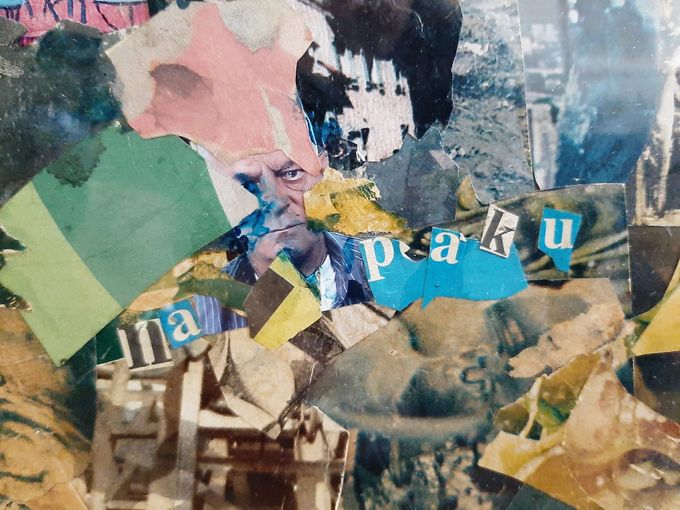
The front consists of a dense accumulation of found imagery. Photographs, fragments of printed matter, colours, bodies and shapes are layered over and beside one another. The image cannot be taken in at once; new details and connections continue to emerge the longer one looks.
Particularly striking is the name NAPAKU, assembled from individually cut-out letters and incorporated directly into the composition. When Piet made the collage in 1969, however, he had not yet adopted Napaku as his artist name. The name must therefore have been added later. Exactly when remains uncertain. It may have been introduced during one of the later interventions, although it is also possible that it dates from a still later stage. In this way, Piet van den Heuvel and his later artistic identity, Napaku, coexist within the same work.
It is the reverse, however, that reveals the long life of the collage most clearly.
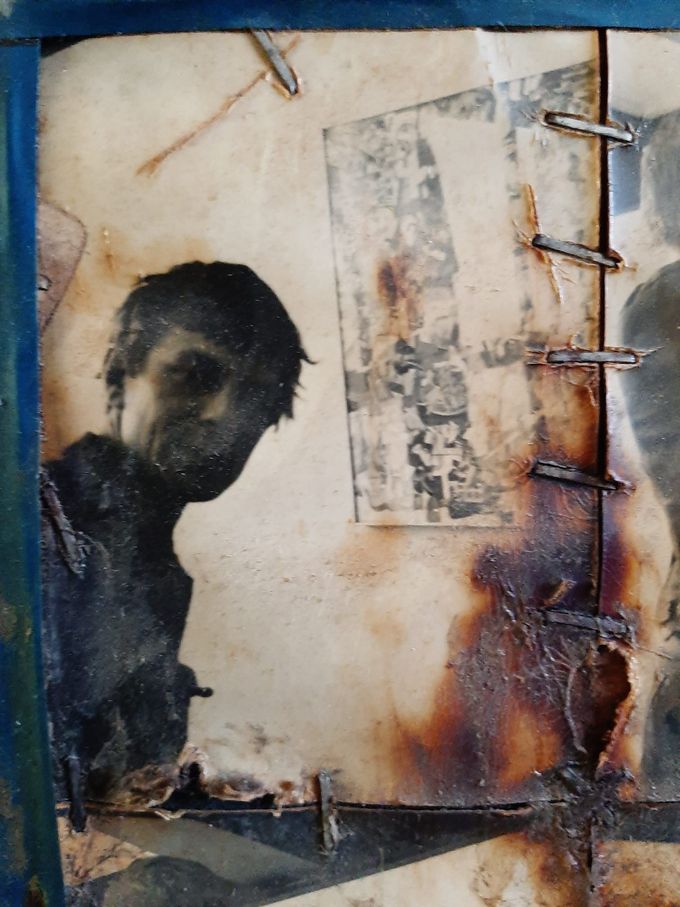
Piet did not treat the back as a neutral support. Photographs, paper, paint, writing, drawings and small objects together form a second composition. The reverse gradually became something close to a personal archive, in which different moments from his artistic career and private life exist side by side and on top of one another.
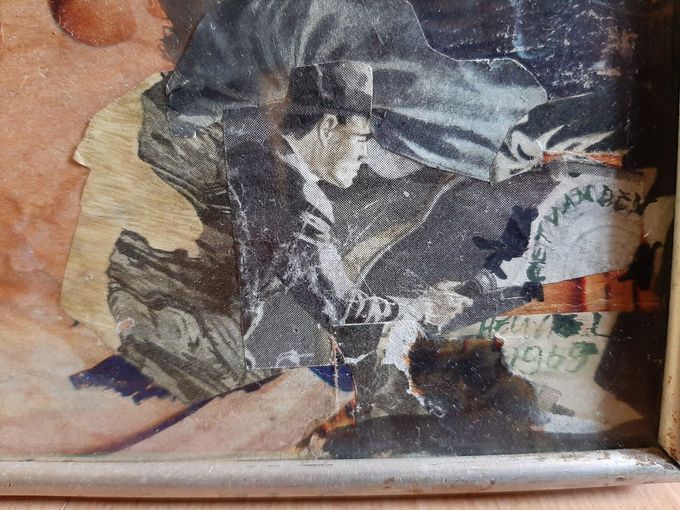
All of the small black-and-white photographs attached to the reverse show Piet himself installing work for another exhibition. This is an important element. The collage therefore contains not only art, but also documentation of the life and practice of an artist: Piet carrying, arranging and hanging his own work. A temporary activity that normally takes place outside the artwork — preparing an exhibition — is incorporated into another artwork and made permanent.
Among these photographs are increasingly personal elements. There is a photograph of Spits, Piet’s dog, as well as a souvenir coin from 1972 bearing the name “Daniel”, referring to his son. A small family keepsake thus becomes permanently embedded among exhibition photographs, texts and found material.
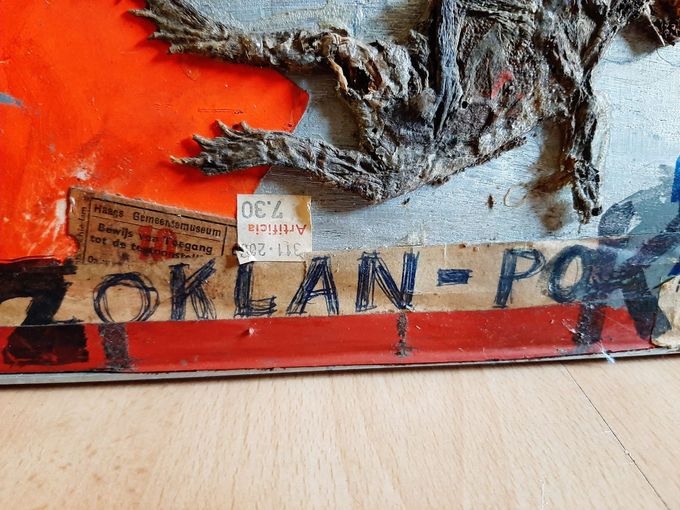
A ticket from the former Gemeentemuseum in The Hague was also incorporated into the reverse. Elsewhere, Piet even attached a completely dried frog to the surface. On this side of the collage, the boundary between image, memory, found object and personal relic almost disappears.
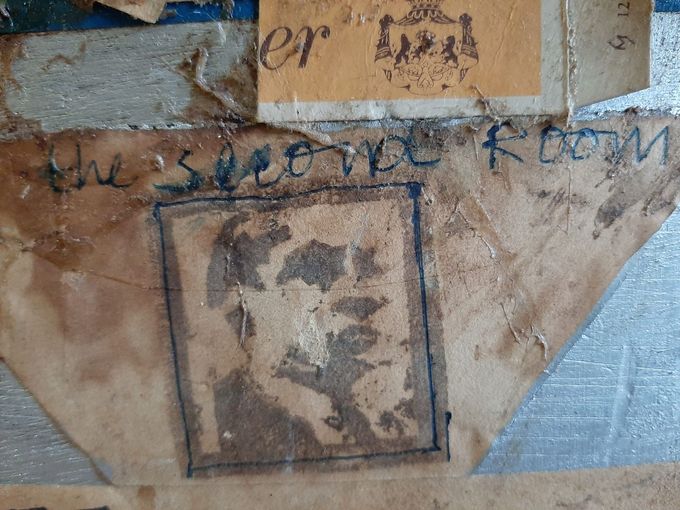
The reverse also contains a reference to The Second Room, one of Piet’s larger, long-term projects. For this project he cut up images of various politicians and recombined fragments of different people to create entirely new figures. Political identities were literally taken apart and reconstructed through collage. The reference on the reverse connects this single object to a much broader strand within Piet’s practice and shows how one work could contain traces of other projects that occupied him over a period of years.
Even more revealing are the handwritten notes in which Piet recorded different stages in the history of the work. Alongside its original creation in 1969, the reverse contains a reference to a repair carried out in November 1977. More than twenty-five years later, another inscription appears:
“Restoration work, 17 July 2003, Amsterdam.”
At least three distinct moments can therefore be identified in the life of the collage: its original creation in 1969, the repair in 1977 and the restoration work undertaken in 2003.
The language of repair and restoration work is significant. For Piet, repairing an artwork does not appear to have meant returning it invisibly to an original state. Repair could become another opportunity to continue working. New images, texts or objects could be introduced, while earlier traces remained visible.
The collage was therefore repeatedly brought into the present.
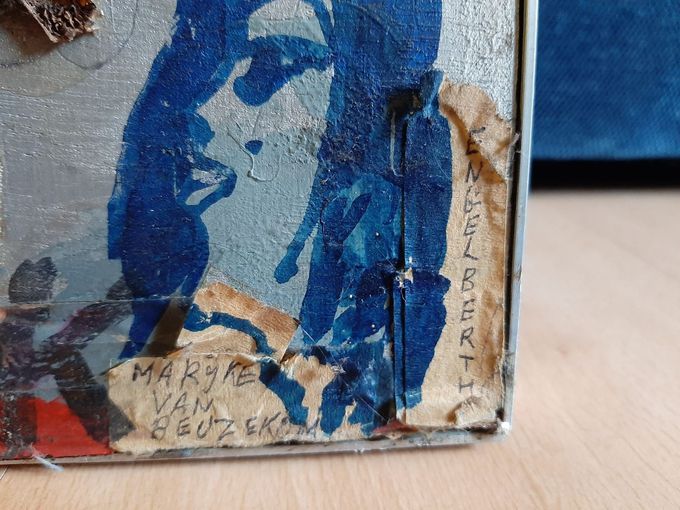
One particularly revealing later addition can be found at the lower right of the reverse, where Marijke Beuzekom, Piet’s second wife, was incorporated into the work. She clearly did not belong to the original context of 1969. Her presence reflects a much later period in Piet’s life and shows how the collage continued to absorb elements of his personal history.
Seen together, the reverse begins to resemble an unintended autobiography. We encounter Piet as an artist installing an exhibition, his dog Spits, a small memento connected to his son Daniel, traces of museum visits, references to his own artistic projects and, later, Marijke. At the same time, Piet himself recorded the moments at which he returned to the object.
The reverse is therefore much more than an accumulation of incidental additions. It connects artistic practice, family life, other bodies of work and everyday experience.
This is what makes the collage particularly compelling. The Piet of 1969, who was not yet working under the name Napaku, exists within the same object as the artist who repaired it in 1977, and as the Napaku who returned to it again in 2003. Between these different moments, the collage spent years travelling aboard the Geertje, the ship of André van den Heuvel.
A simple date such as 1969 therefore tells only part of the story. A more accurate description might be:
Piet van den Heuvel / Napaku, collage, begun in 1969, later altered and repaired in, among other years, 1977 and 2003.
The work ultimately spans more than three decades of a single artist’s life.
Anyone who looks only at the front therefore sees only half the story. It is only when the collage is turned over that its deeply personal character becomes fully visible. The reverse preserves not only traces of materials and repairs, but also people, animals, exhibitions, journeys, other artistic projects and memories.
In the end, the collage is far more than a composition of found images. Napaku did not simply glue paper and photographs together; he also brought together different moments from his own life and work.